RESTORE: Fascia, Movement Variability and Recalibration
I am sure there is a cog somewhere in your screen, where you could default your settings back to certain version of the past. Your computer can revert itself to an earlier state that looks identical to where you were at 3.15pm on Thursday the 23rd of July last summer.
Unlike a machine or a technological device, our body does not return to the same state it was in before.
If you have gone through any stage of transformation, you know this. You might have learnt it through injury, if you have had a baby or simply if you’ve started to feel the passing of time beneath your skin. Even if none of these changes resonate with you, your body went through fast transformation when you were growing. The processes of change from baby to toddler, to child, to adolescent, to young adult are examples of how our body transforms and reorganises as we move through life.
Our organism is in a constant dance of searching for homeostasis, and while we might restore certain aspects of our previous organisation, it cannot reverse history. We have lived an experience, we have transformed.
Restore is the third principle of Moving Fascia. The Moving Fascia principles are orientations that help us investigate the emergence of movement, entry points into practice that bring attention to the ways we participate in the dialogue between movement and form. Between body and movement, investigating the participation of fascia in this reorganisation.
The principle of RESTORE speaks of reorganisation, of the recalibration that is available with each repetition. Our curiosity lies in variability; we become curious about our ways of doing, ways of moving.
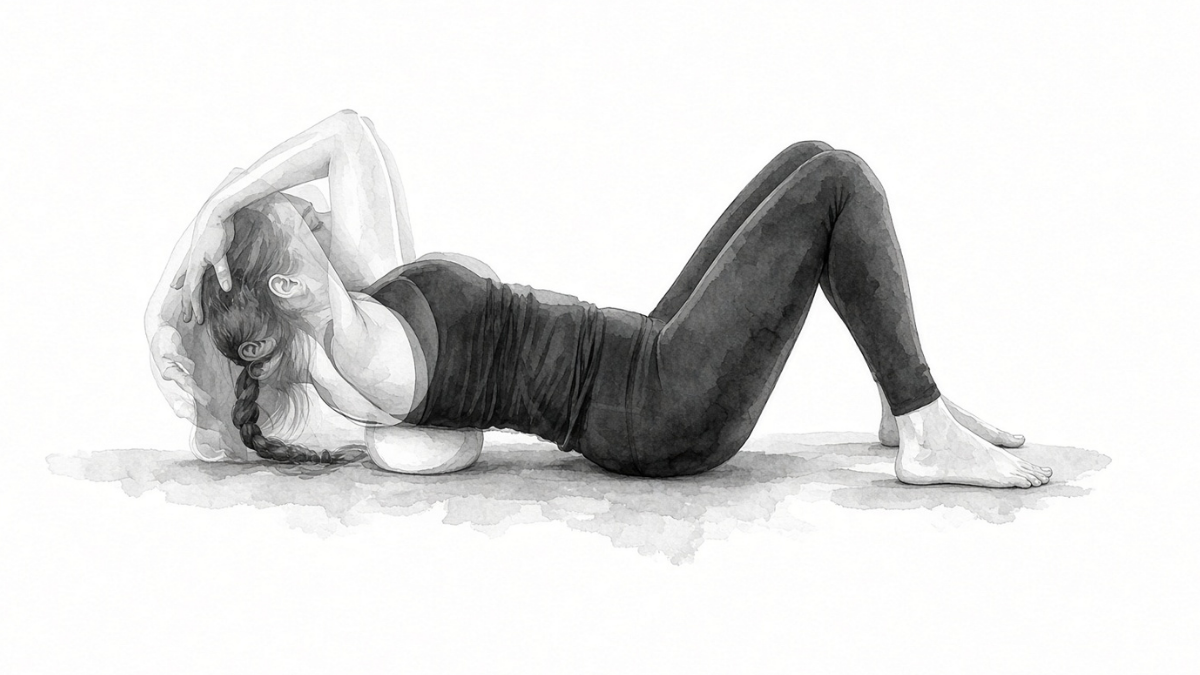
Through this one repetition, I can bring my attention to the way this side of my hand takes the weight as I push into the ground. This repetition might be an opportunity to observe how I transfer the load to the shoulder, how I receive this through the back. I might notice how this influences the way my shoulder blade settles on the ribs, or how my clavicle spirals, or how I reposition my head. I can pay attention to a new sene of recalibration through my spine, and the ways in which I experience relationships within and without, relating to my inner space and the outside environment, and how the seeming threshold between these two might shift.
The principle of RESTORE weaves into the principles of SOFTEN and EXPAND: how we attend to our ability to receive, and how we respond to what might become available. Moving Fascia principles are not a step-by-step process, they don’t follow cause and effect, but offer an investigation into the recursive and reciprocal relationships through which we inhabit our body and movement.
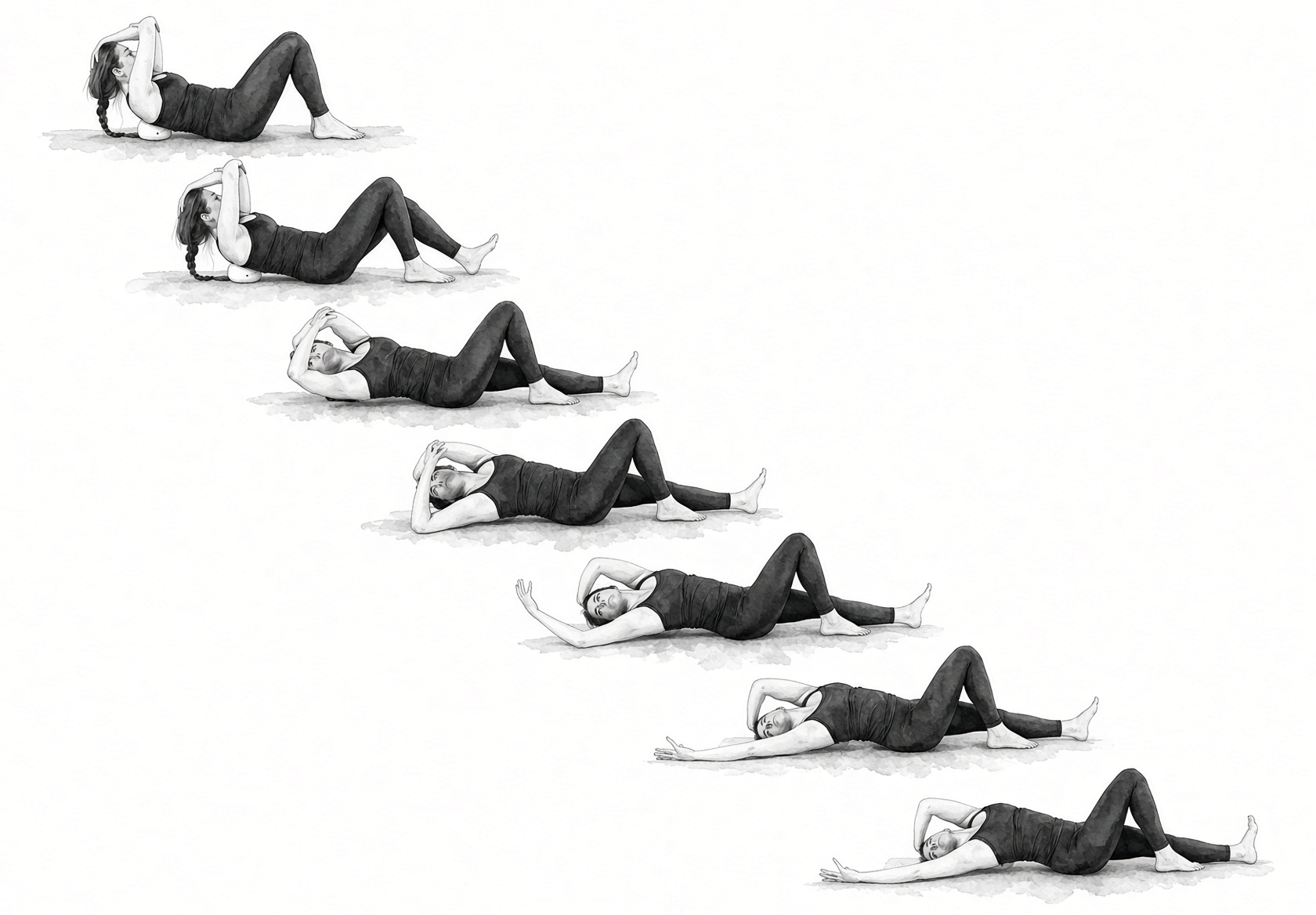
Through RESTORE:
We bring our awareness to this repetition, and then this repetition, and then this one.
Again, and again and again.
You used to be so good at this. Repeating.
Your whole afternoon was based on repeating the same movement again and again and again.
As a baby, as a toddler and then also as a child, the pure joy of movement filled your world.
Through a continual exploration of movement you got to understand your environment and how to related to it.
Your relation to gravity.
Your relation to breath.
To pushing, to reaching, to offering, to taking, to pulling, to yielding back into the floor once more.
Pushing in this way, and then in this way and then this one.
Variability was your forte.
How many ways of pushing are there?
A lot of movement practices focus on the optimum way of moving. And while there are, of course, ways in which we can organise our movement to distribute load more evenly through the joints, and there is potential to rediscover movement pathways that might have become less available to us through habitual patterns of guarding or protection, this discoveries don’t occur through a linear relationship of cause and effect.
Many movement practices begin with an idea of how the body should organise itself to then repeat this ‘optimal’ way again and again. But isn’t this a way of monocropping movement? When the optimal pattern becomes the objective, do we risk stripping movement of the richness of experience? Aren't we cultivating an autocratic relationship with our own bodies rather than opening the door to adaptability and resilience in the long term?
We might become very good at organising ourselves in one particular way, but what happens when the conditions ask for something different? When stability requires us not to hold, but to yield? When the movement we have learnt to repeat is no longer what is required?
Moving Fascia is interested in variability, repetition after repetition in order to meet the difference. What is the difference between this way and this way? Then I can begin to understand my patterns. I can understand how do I do? How do I move?
When I am curious about variability, I receive valuable information about experience, and this information can be both verbal or non-verbal. It could be sensory information, a cognitive choice or a felt sense that can not be put into words, yet it informs my next movement, it offers choices. New choices to move in new ways.
Through repetition, we encounter difference.
Through difference, new possibilities for movement may become available.
This is recalibration.
Not as a return to what was, but as an ongoing process of reorganisation.
Our attention remains with curiosity, with the experience of moving, sensing and relating to ourselves and our environment. And while we are not practising to become resilient, resilience may emerge through this process. Through RESTORE, we investigate our capacity for adaptation, our ability to orient ourselves to the needs of movement unfolding in time and space.
How do I receive what is present?
How do I relate to the choices available to me?
Choice is part of the story of my living process,
and the ways in which I reorganise are part of my own expression.
We restore through recalibration, not through reverting, not though returning back or even by achieving an optimised, ideal way of moving. Because there will be a day when I am walking down an icy road and I will need to engage with gravity, with slipperiness, in a new and different way.
I don't want that day to be a bad day.
I want to be able to attend to the conditions and understand what is needed, how much tone, how much holding. Not because I learnt a stiffness percentage or the optimum way to hold, but because my movement is pretty fluent in receiving, in reading these conditions and respond with what is available.
And then I can walk down the icy road, recalibrating with each step, reorganising as I slide and fall with enough fluidity to have a great day.
October 29, 2026
Ana Barretxeguren
Ana Barretxeguren is a movement educator and fascia practitioner, and the creator of the Moving Fascia® method. Her work explores fascia, breath and movement as lived, relational experience.