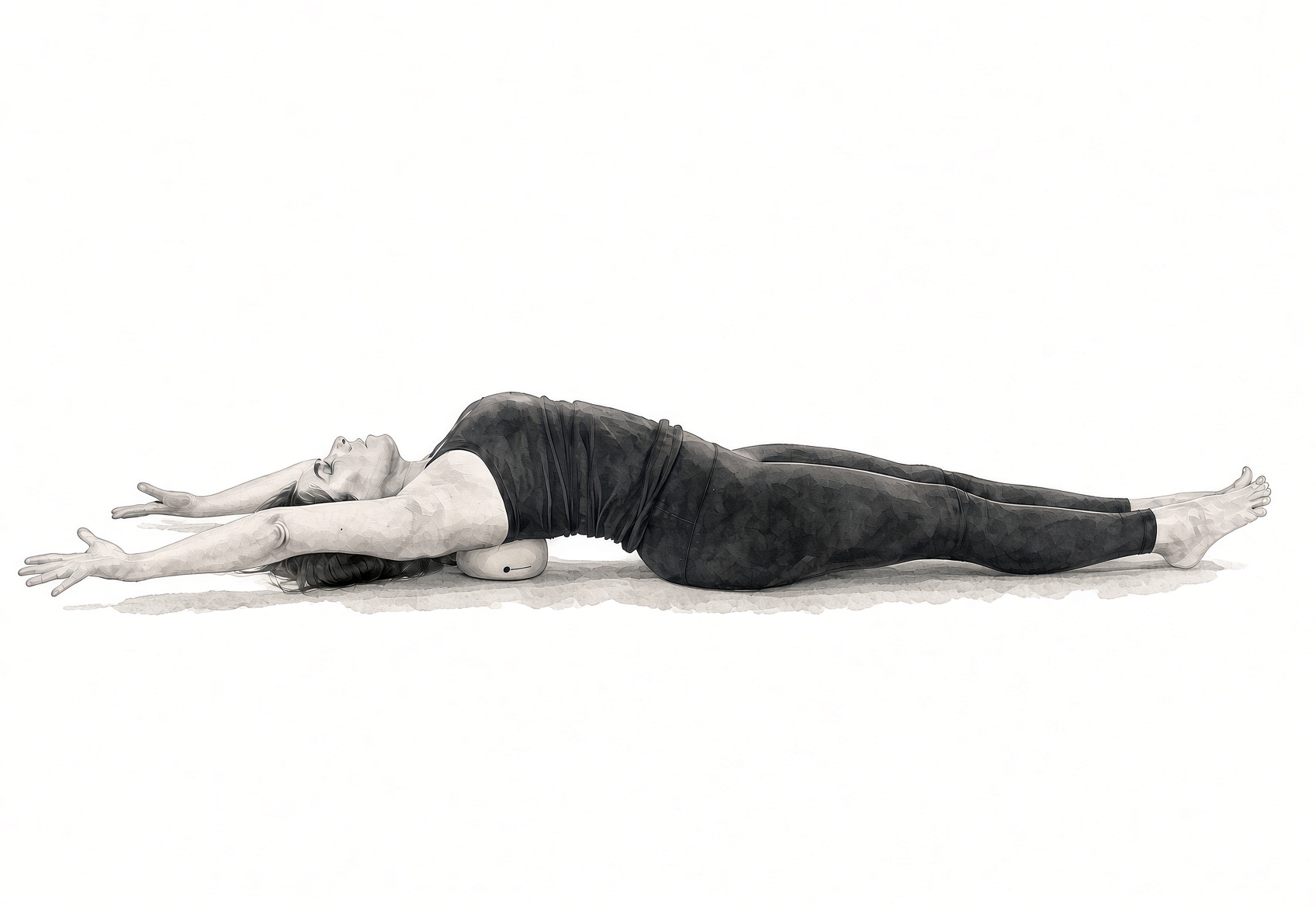
.png)
The Architecture of Moving Fascia
On principles, movement and emergence
SERI are the four principles of Moving Fascia: Soften, Expand, Restore and Integrate.
I think of each of these principles as a doorway into the practice of movement.
We might enter through Soften, paying attention to how we yield, how we receive.
Through Expand, noticing how we respond, how we widen, deepen, lengthen, push into a surface and reach into space, into the world.
Through Restore, exploring how the variation of repetition leads to recalibration, adapting as we reorganise, reorganising as we adapt.
Or through Integrate, attending to how all of these changing relationships influence the way we inhabit our relationship with ourselves, our environment and others.
Each gives us somewhere to begin.
They can serve as a way of entering practice, but they don't tell us what should come next. A doorway doesn't tell us where we will go once we step through it.
So if they are doorways, why use the word principle?
Principle can often be understood to mean something fundamental. Yet the word has its roots in the Latin principium: a beginning, an origin, a foundation or source.
Within Moving Fascia, a principle is not a rule to follow, nor an instruction about what movement should look like.
It is a beginning, a place from which an enquiry can emerge.
Soften, Expand, Restore and Integrate were never conceived as four steps through which movement should progress.
More importantly, SERI emerged from practice, and continues to be informed through practice.
Through more than two decades of moving, teaching, treating, observing and studying the body, certain questions return again and again.
How do we receive?
What expression arises from receiving?
How do we respond to pressure?
What is the quality of our movement as we push into a surface?
Can we yield to meet the ground, meet our own body and meet the quality of our peeling away from the surface?
How do we reach into space?
And what expression does our reaching carry?
How does paying attention to the continuing dialogue of movement invite recalibration, remodulation, adaptation and reorganisation?
And how does the practice of paying attention to what we receive, as well as to our intention, change the way we inhabit ourselves and our movement?
These questions have been part of the underlying architecture of my work for over two decades –through Pilates, through manual therapy, through anatomical and fascial study and, always, through movement. SERI became a way of articulating this architecture.
And if they are doorways, what comes next?
Perhaps a doorway into receiving what is already here teaches us that we are already in the flow of movement.
The doorway is simply a point within this flow.
As we begin to receive, we notice that we are already moving, even in seeming stillness.
We are breathing, participating in taking in and giving out. We are meeting gravity and being met by the ground. We are receiving and expressing.
Yielding into a surface changes the way we meet it. Receiving changes our response. Our response may become a push, a change of direction, a reach into space.
The doorway gives us somewhere to enter, but the movement is already in flow.
What we receive influences what comes next, and what comes next changes what we are able to receive.
This is part of the mutual learning within SERI. We may bring one principle into the foreground, but the others are already present, informing and being informed through movement.
Four interwoven principles. Four doorways into an enquiry already in motion.
Which leaves us with another question:
If the principles don't tell us what comes next, how do we know?
August 27, 2026
Ana Barretxeguren
Ana Barretxeguren is a movement educator and fascia practitioner, and the creator of the Moving Fascia® method. Her work explores fascia, breath and movement as lived, relational experience.