What Is Fascia?
Beyond wrapping and connection
What is Fascia?
Fascia is often described as connective tissue that surrounds, supports and separates structures throughout the body. Yet the term is used in more than one way. In anatomical contexts, fascia may refer to identifiable sheets or sheaths of connective tissue; in broader fascia research, it may refer to a continuous system of loose and dense connective tissues distributed throughout the body.
These definitions are useful, but they also invite particular ways of imagining the body.
The words we use matter. They influence how we think, and when it comes to the body, the language we use to describe our form influences the way we conceptualise, teach, perceive and ultimately how we embody.
The word connective suggests connection. And in a world where disconnection and isolation are increasingly part of our everyday experience, where loneliness is widespread and so much of our attention is absorbed by individual screens, the idea of connection can feel alluring. Perhaps this is one of the reasons fascia has captured so much interest. It offers us an image of connection within ourselves.
We speak of fascial connections, interconnected structures, chains and continuities. And yet I wonder whether, in our enthusiasm to describe everything as connected, we might reinforce the very fragmentation we are trying to move beyond.
Because to connect something, we might first imagine it as separate.
In a subtle way, this language can invite us to picture the body as a collection of independent structures, joined, wrapped or held together by another material, the connective tissue.
But are we really connecting anything?
Our bodies do not come into form this way. Our fascial architecture is not assembled from separate pieces, like a building with components bolted together. Our body emerges through embryonic development, as tissues differentiate, fold, grow and organise in relationship with one another.
We don't begin with separate structures that subsequently become connected. We come into form through processes of differentiation within a developing whole.
And this is why I find the distinction between connection and relationship so important.
Relationship is not simply what happens between structures once they exist.
Relationship is already present in the processes through which form emerges.
Form and movement develop in relationship.
Perhaps understanding fascia asks us to reconsider not only the architecture of the body, but also the language through which we have learned to imagine it.
A Living and Responsive Architecture
And perhaps this fragmented way of imagining the body also comes from our tendency to objectify it.
Objects and machines are often made of parts that are assembled together. We can take them apart, identify their components and understand something about how they function. A living body is not an artefact assembled from pre-existing parts. Its structures emerge, differentiate and continually remodel within a self-organising biological system. And yet, much of our anatomical understanding has developed through the process of taking the body apart.
Dissection separates the body into identifiable structures. And while this has its own value – I have found studying anatomy at an academic level deeply enriching – it can also encourage us to imagine the living body as a collection of separate objects.
In traditional dissection approaches, fascia was often removed and discarded to expose the structures underneath. Into the bucket it went.
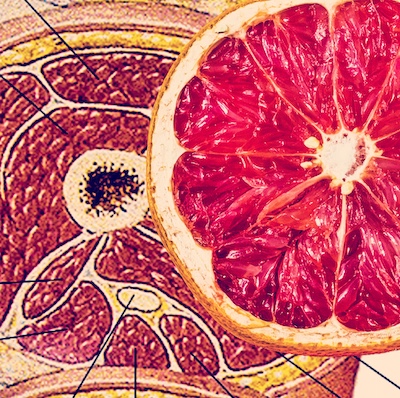
Through dissection, we are interested in understanding the body by cutting it apart, separating tissues to identify and name discrete structures: muscles, organs, vessels, nerves and glands. In this separation we can also lose sight of the relationships that organise them in the living body. And as we loose sight of relationship we risk mistaking the anatomically defined structures we sculpt for the living body itself.
We create a map of the body.
I'm sure you are familiar with Korzybski's observation that the map is not the territory.
The map may be useful, but it is not the living body itself.
A similar fragmentation, occurring at another scale and in another dimension, can happen when we describe fascia through its individual components. A description of fascial components might begin to resemble a soup recipe: cells, fibres and nerve endings within a liquid medium, the ground substance, containing water and molecules such as hyaluronan.
• There are fibroblasts, mechanosensitive cells that respond to mechanical, chemical and metabolic cues and participate in continual remodelling of our architecture.
• There are fibres, such as collagen and elastin, creating a scaffolding whose weave and organisation contribute to tensile strength, pliability and the capacity for movement within our tissues.
• There is hyaluronan, one component of the extracellular matrix. Its properties may influence low-friction gliding at certain tissue interfaces, while providing an environment for movement, communication and protection
• Fascial tissues are innervated, although their neural organisation varies between regions. They contain sensory nerve endings and, in some tissues, autonomic nerve fibres. Signals from fascia contribute to the nervous system’s perception of bodily position, movement, internal state and pain.
These 'ingredients' are not independent of one another. They are continually interacting, responding and participating in the organisation of our living architecture. They are in relationship.
Fascia is living and responsive. Fascia is not an inert wrapping. Fascia is no object.
And yet, here we are, listing these ingredients a little like a delicious menu displayed at a restaurant.
But we are not the menu.
We are the meal.
And the meal cannot be reduced to its ingredients. The experience also depends on flavour, smell, texture, memory, culture, the conditions in which the food was grown, the surrounding ambience and the company.
All of this and more participates in the experience of our meal.
And in our body and movement, this complexity is also unseen, yet very much present.
Understanding fascia invites us to reconsider the body, not as a collection of structures assembled together, but as a living architecture that has emerged through development and continues to participate in movement.
Anatomical description is necessary, but it is not sufficient. There is also an understanding that arises through experience: through movement, through the way we receive sensory information, and through how we respond to and participate in a continually changing environment.
A subtle shift of weight may change what we notice.
A different point of contact may influence how we organise ourselves.
Sometimes a small movement invites an unexpected response elsewhere.
Perhaps this is where our understanding of fascia becomes particularly interesting: not simply in recognising that everything is connected, but in becoming curious about the relationships that allow us to move, perceive and adapt.
Within the Moving Fascia® Method, we explore this living architecture through movement, cultivating awareness of the relationships through which we perceive, respond and adapt.
For those wishing to explore this journey in greater depth, Moving Fascia Foundations offers an opportunity to investigate our emerging fascial architecture, from early embryonic development to the ongoing relationships between form, movement and sensory experience.
October 8, 2026

Ana Barretxeguren
Ana Barretxeguren is a movement educator and fascia practitioner, and the creator of the Moving Fascia® method. Her work explores fascia, breath and movement as lived, relational experience.